Quick Start (Read This First)
- Vacuum slowly. Fast vacuuming stirs debris into a cloud.
- Prime (fill) the vacuum hose with water. Air in the hose can cause the pump to lose "prime" or weak suction.
- Watch the skimmer basket and filter pressure. If flow drops, stop and clean skimmer and/or pump basket / backwash as needed.
- Know when to vacuum to “Filter” vs. “Waste.” When the filter multiport valve is set to “Waste”, it bypasses the filter and sends water out—great for heavy silt or floc, but you’ll lose water; so keep an eye on the water level in the pool if you filter to "Waste". When vacuuming to "Waste" you may want to slightly overfill the pool to accommodate for the water loss while vacuuming.
- These are Generalized Steps and may not apply to your swimming pool or system as swimming pool installation and filter plumbing installations vary.
What You Need (Checklist)
Core items (for both above ground and inground pools)
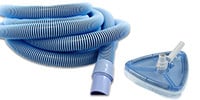
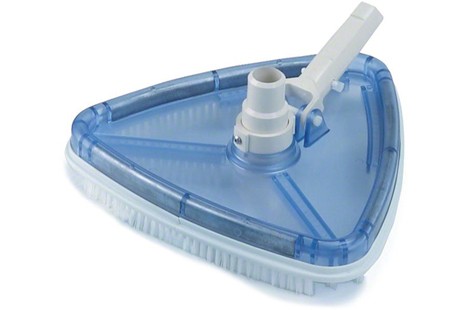
- Vacuum head (a weighted vacuum head is easier to keep on the floor)
- Telescopic pole that will at least reach halfway across the pool
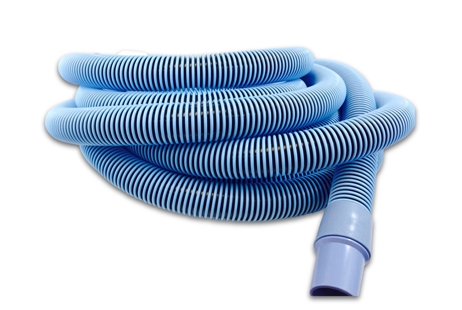
- Vacuum hose (correct diameter and length for your pool)
- Skimmer connection method (varies by pool type—see below)
- Leaf rake/net (to remove big debris first)
- Brush (optional but recommended to loosen debris)
Recommended add-ons (make vacuuming easier)
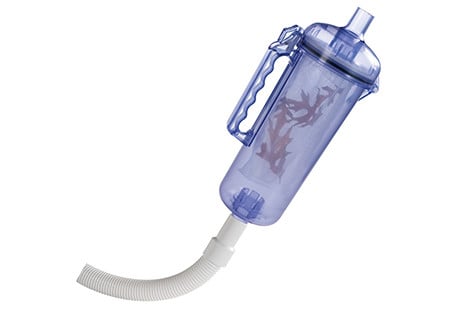
- Leaf canister (especially helpful for leaves/acorns so they don’t clog the pump basket)
- Hose swivel cuff (reduces twisting)
- Spare skimmer basket and spare pump basket lid O-ring (air leaks kill suction)
Before You Vacuum (Don’t Skip These)
- Skim first. Remove leaves and floating debris so you don’t clog baskets immediately.
- Brush if needed. Brush walls/floor to loosen stuck dirt (then give it 5–10 minutes for any loosened debris to settle).
- Check water level. Water should be at least halfway up the skimmer opening (too low = the skimmer gulps air, the pump loses prime and you cannot vacuum).
- Empty baskets. Clean the skimmer basket and pump basket before you start.
- Know your filter type:
- Sand filter: backwash when pressure rises ~20–25% over clean pressure.
- Cartridge filter: suction drops as the cartridge loads; you may need to rinse/clean mid-job if it’s very dirty.
- DE filter: may need backwash + DE recharge (follow your filter’s label/instructions).
Above Ground vs. Inground: What’s Actually Different?
| Step | Above Ground Pool | Inground Pool |
|---|---|---|
| Where the hose connects | Usually the skimmer using a skimmer vacuum plate or adapter (inside skimmer or just below skimmer mouth opening) | Skimmer with a vacuum plate OR a dedicated vacuum port/line |
| Common extra part | Skimmer vacuum plate sized for your skimmer | Vacuum plate OR vacuum port fitting (depending on your setup) |
| Valve settings | Usually simple (pull water from skimmer only). Some systems have a 2-way valve. | May have multiple suction lines (skimmer/main drain/vac line) and diverter valves. (pull water from skimmer only) |
| Vacuum to Waste (As Needed) or Vacuum in Filter setting | Possible if you have a multiport and waste line; many above ground setups are “filter only.” | More common; multiport valves often support “WASTE.” Great for fine sediment or floc. |
How to Manually Vacuum an Above Ground Pool (Step-by-Step)

Step 1: Assemble the vacuum
- Attach the vacuum head to the telescopic pole.
- Attach one end of the vacuum hose to the vacuum head (often a friction-fit cuff).
- Lower the vacuum head into the pool and rest it on the floor.
Step 2: Prime (fill) the vacuum hose with water
This is the #1 step that determines suction. Your goal is to remove air from the hose.
- Method A (easy): Hold the free end of the hose in front of a return jet until water pushes bubbles out of the hose and it feels “heavy.”
- Method B: Feed the hose straight down into the pool, section by section, until it fills completely with water.
Step 3: Connect to the skimmer (typical above ground setup)
- Turn the pump OFF (recommended while you connect).
- Remove the skimmer lid.
- Empty the skimmer basket if needed.
- Install your skimmer vacuum plate (some sit on top of the basket; some replace the basket—follow your part style).
- With the hose still full of water, insert the free end of the hose into the vacuum plate opening.
- Make sure the connection is snug—air leaks here reduce suction.
- Turn the pump ON.
Step 4: Vacuum technique (above ground)
- Move in slow, overlapping passes, like mowing a lawn.
- If you see debris “puff” into a cloud, slow down and let it settle for a minute.
- Keep the vacuum head flat so it doesn’t lose contact and stir up sediment.
- If suction drops:
- Stop and clean the skimmer basket and pump basket.
- Check for a kinked hose or air being pulled at the skimmer.
Step 5: After vacuuming (above ground)
- Turn the pump OFF.
- Remove the vacuum plate/adapter and reinstall the skimmer basket/lid.
- Empty baskets again.
- Check filter condition:
- Sand/DE: backwash if pressure is up ~20–25%.
- Cartridge: rinse/clean if flow is reduced.
- Top off water if needed and re-balance chemistry (vacuuming can stir fine debris that impacts clarity).
How to Manually Vacuum an Inground Pool (Step-by-Step)

Step 1: Assemble the vacuum (same as above ground)
- Vacuum head on pole.
- Hose to vacuum head.
- Lower head to the floor.
Step 2: Prime (fill) the hose with water
Use the same priming method: return jet or feed the hose down until it’s fully water-filled.
Step 3: Choose your connection type
Option A: Vacuum through the skimmer (common)
- Turn the pump OFF (recommended).
- Open the skimmer lid and remove the basket.
- Install a skimmer vacuum plate (or a skimmer adapter/elbow that accepts the hose cuff).
- Insert the water-filled hose end into the vacuum plate/adapter.
- Turn the pump ON.
Option B: Vacuum through a dedicated vacuum port/line
- Turn the pump OFF (recommended).
- Remove the vacuum port cover (often on the wall, just below the waterline, sometimes marked “VAC”).
- Attach the correct vacuum port fitting if required (varies by pool).
- Insert/attach the water-filled hose end to the vacuum port connection.
- Turn the pump ON.
Step 4: Set suction valves for best vacuum power (inground)
Many inground pools have multiple suction sources (skimmers, main drain, vacuum line). If you have valves:
- Increase suction to the line you’re using (skimmer or vacuum line).
- Reduce suction from other lines slightly (don’t fully close a line unless your system is designed for it).
- If unsure, make small adjustments and watch the pump basket for steady, bubble-free water flow.
Step 5: Decide “Filter” vs. “Waste” (inground multiport systems)
Most routine vacuuming: set to FILTER.
Vacuum to WASTE (if available) when:
- You have heavy fine sediment/silt that clogs filters quickly.
- You used flocculant and debris is settled on the floor (vacuuming to filter will cloud the pool).
Important: Vacuuming to WASTE lowers water level fast—keep a hose filling the pool or stop and refill as needed.
Step 6: Vacuum technique (inground)
- Slow, overlapping passes.
- Use gentle turns (sharp turns lift the head and stir debris).
- Keep the hose submerged; if it sucks air, stop and re-prime.
- Watch the filter pressure gauge and pump basket for clogging.
Step 7: After vacuuming (inground)
- Turn pump OFF.
- Disconnect hose and reinstall skimmer basket/port cap.
- Empty skimmer + pump baskets.
- If you vacuumed to WASTE, bring water level back up before restarting normal circulation.
- Service the filter:
- Sand: backwash (then “RINSE” if your valve has it, typically 15–30 seconds).
- DE: backwash as needed and recharge DE per your filter label.
- Cartridge: rinse/clean cartridge if flow is reduced.
Common Mistakes (and How to Fix Them)
Problem: No suction or weak suction
- Air leak at skimmer/plate/hose cuff: reseat the connection; check O-rings and hose cuffs.
- Hose not fully primed: re-prime until bubbles stop.
- Low water level: raise level to mid-skimmer or higher.
- Clogged baskets or filter: clean skimmer + pump baskets; backwash/clean filter.
- Valve not set for vacuum line: adjust suction valves to favor the line you’re using.
Problem: Dirt blows back into the pool
- Filter overloaded: backwash/clean filter; vacuum slower.
- Cartridge/DE issues: cartridge may be clogged or DE may need proper recharge (follow filter instructions).
- Too-fine debris: consider vacuuming to WASTE if your system supports it.
Problem: Vacuum head won’t stay down / keeps lifting
- Use a weighted vacuum head or add hose weights.
- Slow down—fast movement creates lift and turbulence.
Pro Tips to Make Manual Vacuuming Easier
- Use a leaf canister when vacuuming big debris. It traps leaves before they hit your pump basket.
- Vacuum in a pattern: shallow end to deep end, or one lane at a time.
- Let dust settle: if you brushed or shocked recently, give the pool time to settle before vacuuming.
- Record your “clean filter pressure.” Write it on the filter tank with a marker so you know when to service it.
FAQ
How often should I manually vacuum?
Most pools benefit from weekly vacuuming, or as needed after storms, heavy swimmer load, or nearby landscaping work.
Should I vacuum on “Filter” or “Waste”?
Use “Filter” for normal dirt and debris. Use “Waste” (if available) for heavy fine sediment or after flocculant so you don’t cloud the pool and overload the filter.
Do I need to turn the pump off when connecting the hose?
It’s recommended. It prevents sudden air ingestion and makes it easier to keep the hose primed while you connect.
My hose floats and sucks air—what do I do?
Re-prime the hose and consider hose weights. Also confirm the water level is high enough and there are no air leaks at the connection points.